The ancient province of Tsukushi (筑紫), or Tsukushi no Kuni (筑紫国), divided in the year 645 into the provinces of Chikuzen (筑前) and Chikugo (筑後), corresponds to modern Fukuoka Prefecture, excluding its eastern part, which fell within the ancient province of Toyo no Kuni (豊国).
The minka found across the plains of Tsukushi are called kagi-ya-zukuri or kagi-ie-zukuri (鍵家造り, lit. ‘key house style’). Their plans are rectangular (kukei 矩型) layouts that can be found anywhere, but their roof ridges (yane-mune 屋根棟) describe an L (eru-gata L型) or U (yū-gata U型) form, and these minka present a unique external appearance. The thatched (kusa-buki 草葺き) roofs can also be found in other, more complex variations, and these too are designated by a letter of the alphabet or katakana character that best resembles them in plan: yu-gata (ユ型), ro-gata (ロ型), yo-gata (ヨ型), T-gata (T型), and so on. The parts of the dwelling not covered by these thatched roofs is covered by tiled (kawara-buki 瓦葺き), shallow-pitched lean-to roofs. Along the famous scenic sea coast of Saga Prefecture there are particularly many yū-gata (U型), also known as о̄-gata (凹型), roofs, whose appearance when viewed from the rear (the leg or ‘prong’ side of the U) is reminiscent of a curved Japanese stove (kudo くど or kamado 釜土), hence the name kudo-zukuri (くど造り, ‘stove style’).
There are various factors behind the adoption of such complex roof forms: one is that, under the Shogunate, beam spans (hari-ma 梁間), and therefore building widths, of over two ken (ni-ken 二間, around 3.6 metres) were prohibited to commoners in the Saga domain (Saga-han 佐賀藩); another reason given is that, in order to minimise damage from typhoons, the ridge is divided up into several lower ridges, in a similar manner as seen in the ‘divided ridge style’ (buntо̄-zukuri 分棟式) minka common from southern Kyūshū (Kyūshū nanbu 九州南部) to the Nansei Islands (Nansei shotо̄ 南西諸島), which, even after being unified into one (interior) volume, retained separate ridges, like the shumoku-zukuri (撞木造り) style covered in a previous post on minka styles. Additionally, because in this region there is a lot of reclaimed land (kantaku-chi 干拓地) and the rivers are high in salt content, trees do not reach a great size, so windbreaks (bо̄fū-rin 防風林) cannot be cultivated. Building in the kudo-zukuri style, in which scarce timber can be assembled into a robust roof structure, is burdensome work, but on the plains and with nothing to block strong sea winds, it is well-suited to the climatic and material conditions (fūdo 風土) of its location.
The picture below shows an о̄-ji-gata (凹字型) minka seen from the rear; visible at the ends of the ridge are the projecting members called min-no-su (みんのす). There are also projections, called shigi-saki (しぎさき, ‘shigi tip’) at the ends of the hips (kudari-mune 下り棟 or sumi-kudari-mune 隅降り棟) of the tiled lower roof; the name shigi-saki comes from the fact that in this area, the kudari-mune are called the shigi, (主稜, lit. ‘main edge’). The ridge is laid with cylindrical fired clay tiles, similar to sections of earthen pipe (dokan 土管), split in two, called kame-gawara (かめ瓦, perhaps ‘turtle tile’), secured in place with bamboo skewers (take-gushi 竹串) pushed through holes made in the sides of the tiles.
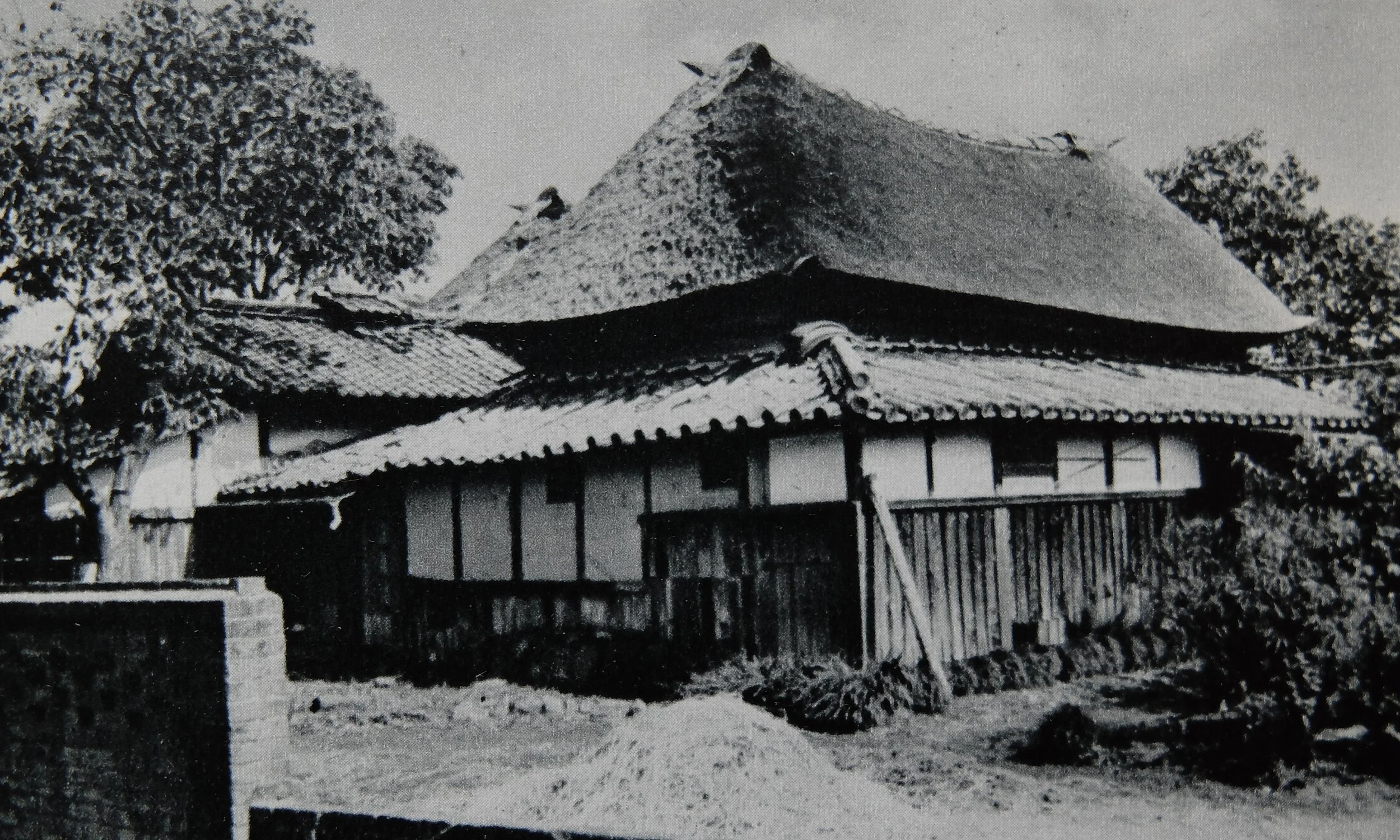
An о̄-ji-gata (凹字型) minka seen from the rear; showing the tiled ridge, lower tiled roof, and the projecting members called min-no-su (みんのす) and shigi-saki (しぎさき, ‘shigi tip’). Saga Prefecture.
The ridge of the minka in the picture below takes a yu-no-ji (ユの字) form; the roof consists of seven hips (shigi 主稜) and three valleys (tani 谷) and is called a san-dani nana-shigi zukuri (三谷七主稜造り ‘three valley seven shigi style’) roof.
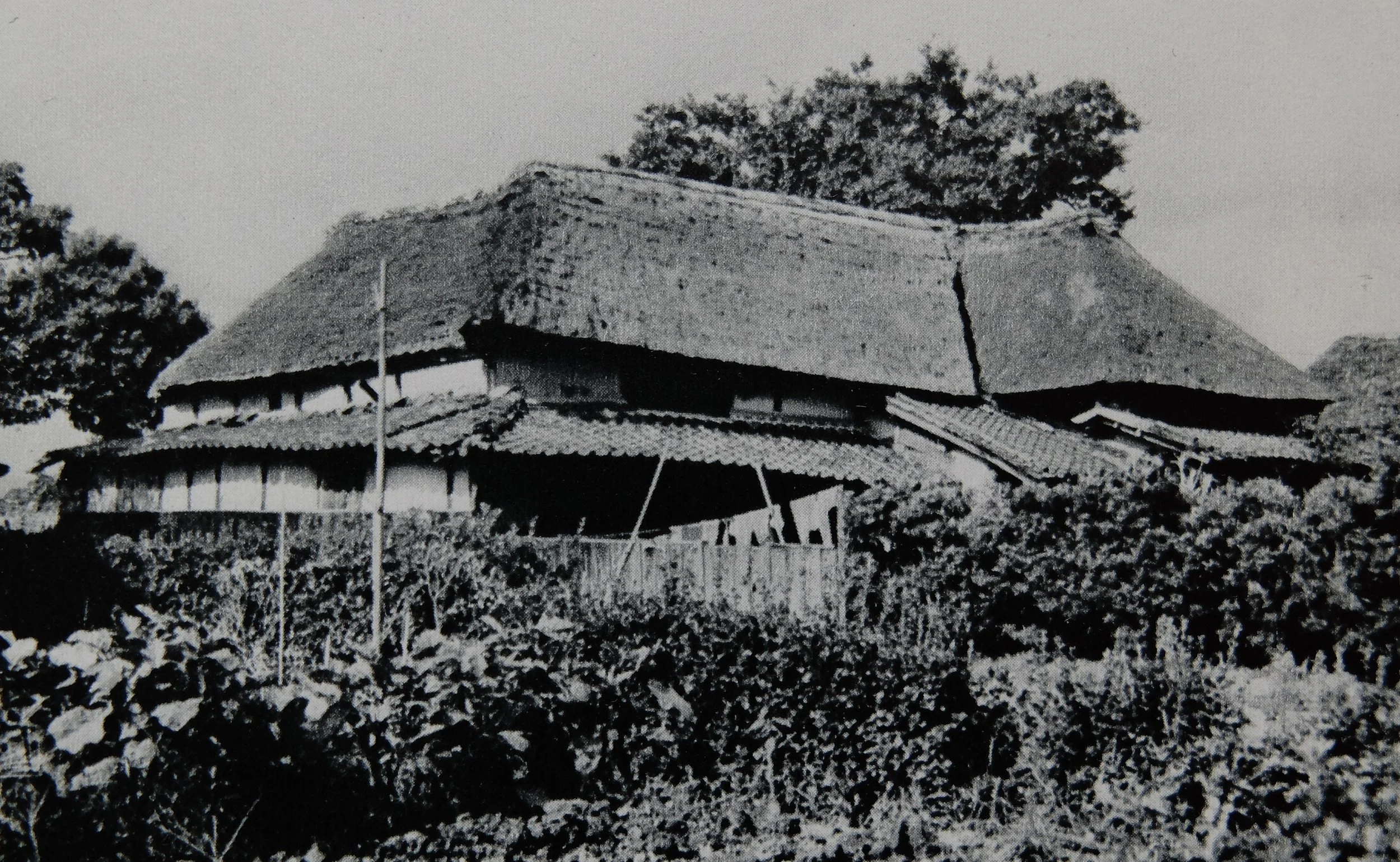
A yu-no-ji (ユの字) form minka, with a ‘t hree valley seven shigi style’ (san-dani nana-shigi zukuri 三谷七主稜造り) roof. Saga Prefecture.
The ridge of the dwelling in the picture below has a ro-no-ji (ロの字) form; since rainwater falling on the inner faces of the roof is collected at a single point at the centre of the house, this style is called jо̄go-zukuri (じょうご造り ‘funnel style’).
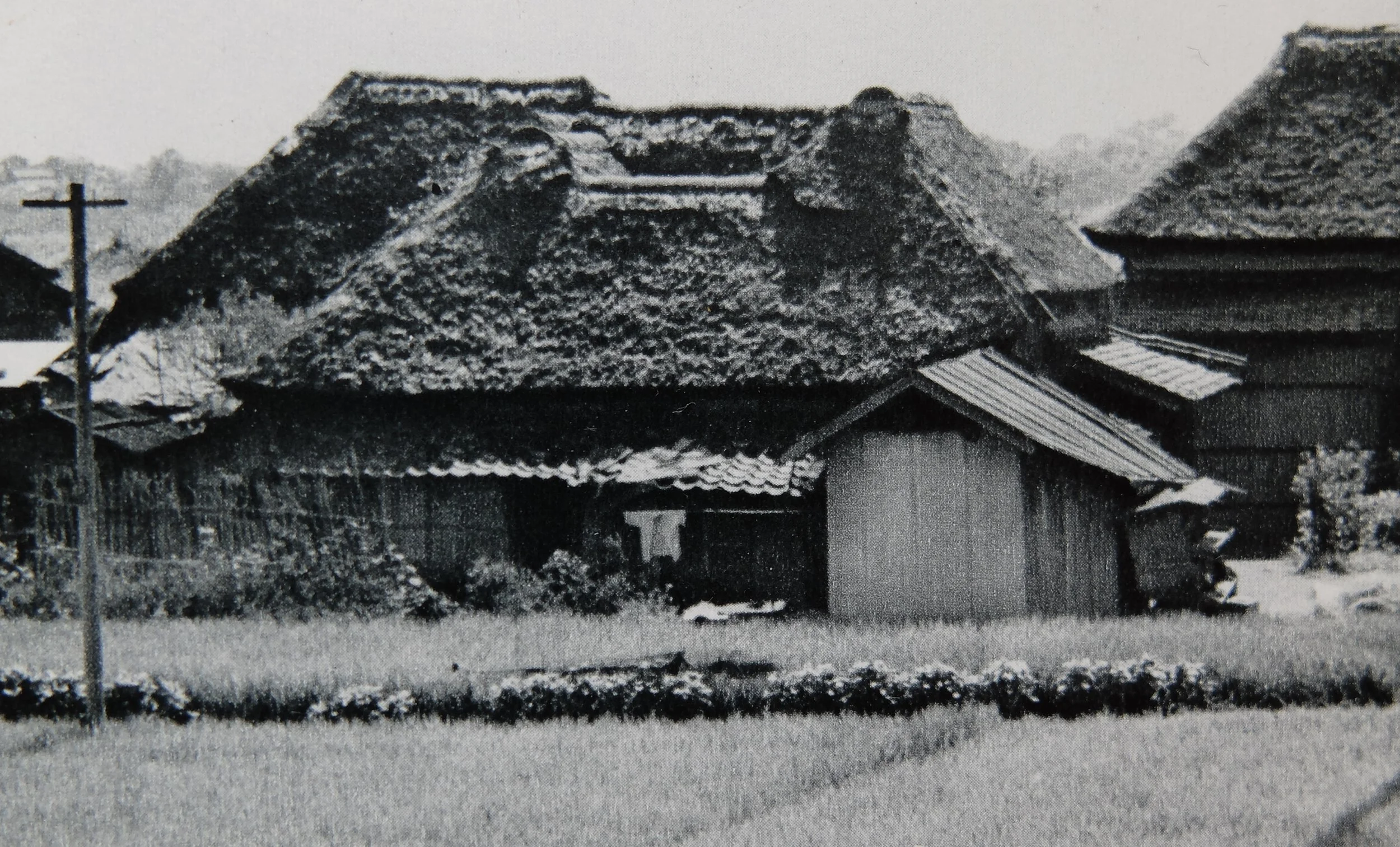
A ro-no-ji (ロの字) form ridge, the so-called ‘funnel style’ (jо̄go-zukuri じょうご造り). The ridge height gets lower as it goes along. 順送り. The rainwater that collects at the centre of the house is conveyed out by a gutter. Saga Prefecture.
The internal layout of the kudo-zukuri consists of a doma-less (mu-doma 無土間) main volume (omo-ya 主屋) with a front-zashiki three-room layout (mae-zashiki san-madori 前座敷三間取り) and an earthen-floored (doma 土間) ‘farm work place’ (nо̄-sagyо̄-ba 農作業場), with these two volumes (ni-tou ニ棟) adjoining and parallel; around Kumamoto (熊本), this style is known as ni-tou-zukuri (二棟造り, ‘two ridge style), futatsu-ya zukuri (二つ家造り, ‘two house style’), or futatsu-ze tsukuri (二つ背造り, ‘two back style’). The ridges of these two volumes run front-to-back; the purpose of the ridges that run side-to-side, perpendicularly connecting these main ridges across the façade and rear, can be regarded as cosmetic, to ‘maintain appearances’. In this type of house, a gutter can be seen running overhead in the doma; it carries out rainwater collected by the funnel-form roof, and is a simple device consisting of overlapping half-cylindrical tiles laid between two logs or poles.