In the adjoining districts of Itsuki (五木) and Takachiho (高千穂) and in the Sekiryо̄ mountains Sekiryо̄ sanchi (脊梁山地), all on the island of Kyūshū (九州), there is a style of minka in which all the rooms are arrayed in a single line on the longitudinal axis (parallel to the ridge); in Shiiba (椎葉), this style is called sao-ya zukuri (竿家造り, ‘pole house style’), in reference to the long, narrow form of the houses. This type of plan-form is common in steep mountainous country where deep sites cannot be obtained, and can be found in places such as the Chichibu mountains (Chichibu sanchi 秩父山地) and Oku-mikawa (奥三河) in central Honshū, the Kiwa mountains (Kiwa sanchi 紀和山地) on the Kii Peninsula (Kii Hantо̄ 紀伊半島) in western Japan, and the Iya district (Iya chihо̄ 祖谷地方) on the island of Shikoku (四国).
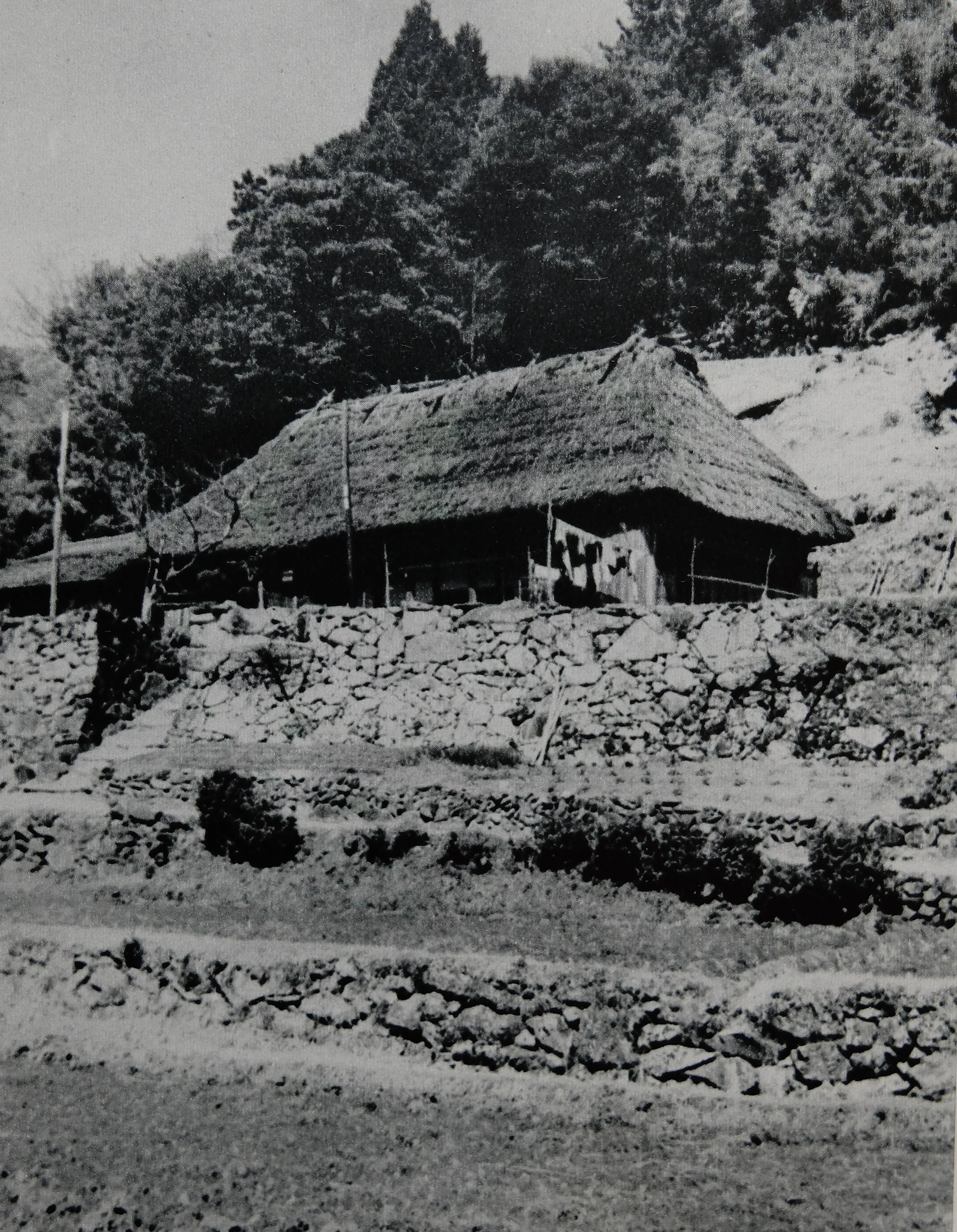
The site of this sao-ya-zukuri is on a mountain side (sanpuku 山腹) that is cut into terraces (hinadan-jou 雛壇状 ‘doll stand form’), and the building lot (takuchi 宅地) is shallow in depth, so a long, narrow plan-form is inevitable, and any auxiliary buildings (fuzoku-ya 付属家) are erected beside the main dwelling on the same contour. Miyazaki Prefecture.
In these isolated mountain villages there are invariably legends of fugitives (ochi-udo densetsu 落人伝説) who fled to live in them after the defeat of their clan. In the village of Shiiba (椎葉村), too, a tale has been passed down that fugitives of the Taira (平) clan (Heishi 平氏) or ‘House of Taira’ (Heike 平家) settled there after their defeat by the Minamoto (源) clan (Genji 源氏) or ‘House of Minamoto’ (Genke 源家) in the Genpei war (Genpei-gassen 源平合戦, 1180 - 1185), and it is said that the internal layout of the sao-ya is drawn from the lineage of the shinden style (shinden-zukuri 寝殿造り), the residential architecture of Heian-era (Heian jidai 平安時代 794 - 1185) nobility. The shinden-zukuri consists of three parts: the main building (omo-ya 主屋), called the moya (母屋, ‘mother roof’); its encircling perimeter corridor, the hisashi (廂); and the mago-bisashi (孫廂, ‘grandchild corridor’), the ‘verandah’ on the exterior side of the hisashi.
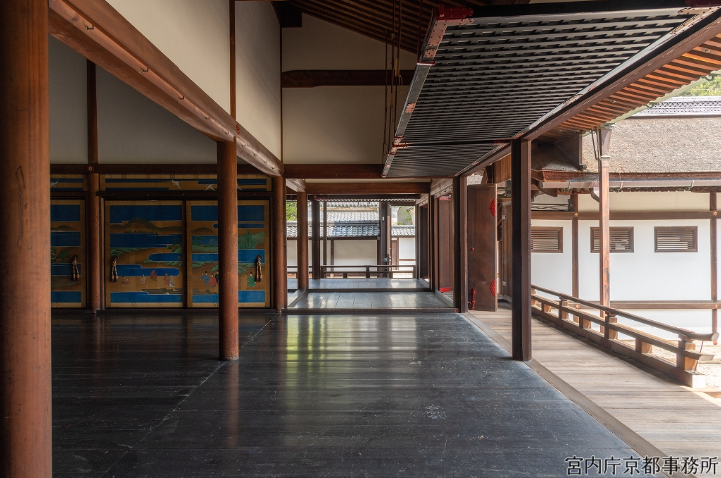
Photograph of Kyо̄to Imperial Palace (Kyо̄to Gosho 京都御所), showing the three-part spatial structure of shinden-zukuri architecture: on the left, the moya (母屋); centre, the hisashi (廂); on the right, the mago-bisashi (孫廂).
The sao-ya-zukuri houses of the Shiiba region are also composed of three analogous parts, though they are arranged in parallel rather than concentrically: the rearmost ‘habitable rooms’ (kyoshitsu 居室), called the o-hara (おはら); the intermediate, interior ‘wide verandah’ (hiro-en 広縁), called the soto-hara (そとはら) or shita-hara (したはら); and the outermost, exterior ‘verandah’ (engawa 縁側) proper, called the hi-en (ひえん). Between the rooms of the o-hara and those of the soto-hara there were no partitions, only ‘blind sills’ (mekura-jikii 盲敷居) called nageshi (なげし), i.e. threshold members without grooves to accept sliding fittings; in past ages when status distinctions were strictly observed, those of low status could not enter any deeper into the house than the nageshi.
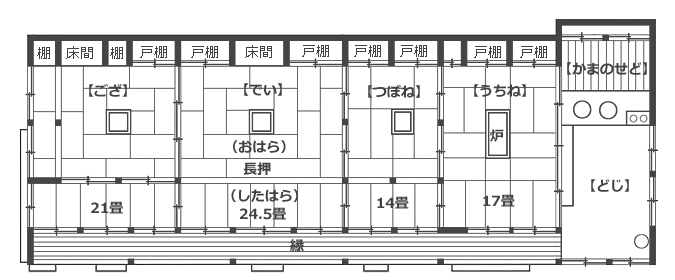
Floor plan of a sao-ya-zukuri minka, showing, from right to left, the earth-floored utility area (doji どじ), the kitchen (kama-no-sedo かまのせど), the living-dining space (uchine), a somewhat more formal room called the tsubone (つぼね), the formal reception room (dei でい), and the bedroom (goza ござ). Each of these spaces has a rear o-hara (おはら) part and a facade-side soto-hara (そとはら) or shita-hara (したはら) part: in the uchine these two parts are continuous; in the tsubone and dei they are delineated only with by a blind sill (mekura-jikii 盲敷居); in the goza they are properly partitioned with sliding fittings and a short flanking wall. The rear wall is also blind, completely occupied with shelves (tana 棚), cupboards (todana 戸棚), and decorative alcoves (tokonoma 床間).
Since the ‘surface’ of the mountain (yama-hada 山肌) is right at the rear of the house, the north side has no windows; it is lined instead with varieties of closet (oshi-ire 押入) and cupboard (todana 戸棚). Of the rooms, the dee (でえ), the ‘main room (shushitsu 主室), is a formal reception room (sekkyaku zashiki 接客座敷) used for socialising with neighbours and relatives, but on the occasion of the autumn festival (aki-matsuri 秋祭り), when Shintо̄ music and dancing (kagura 神楽) are offered up (hо̄nо̄ 奉納), it becomes a stage (butai 舞台); the combined living (ima 居間) and dining (shokudо̄ 食堂) space, called the uchinee (うちねえ), serves as the ‘green room’ or ‘backstage’ (gaku-ya 楽屋), and the audience sits in the bedroom (shinshitsu 寝室), called the koza (こざ) or goza (ござ), and in the soto-hara. The distinguished houses (taika or taike 大家) of the hosting villages take it in turns to put on the kagura.
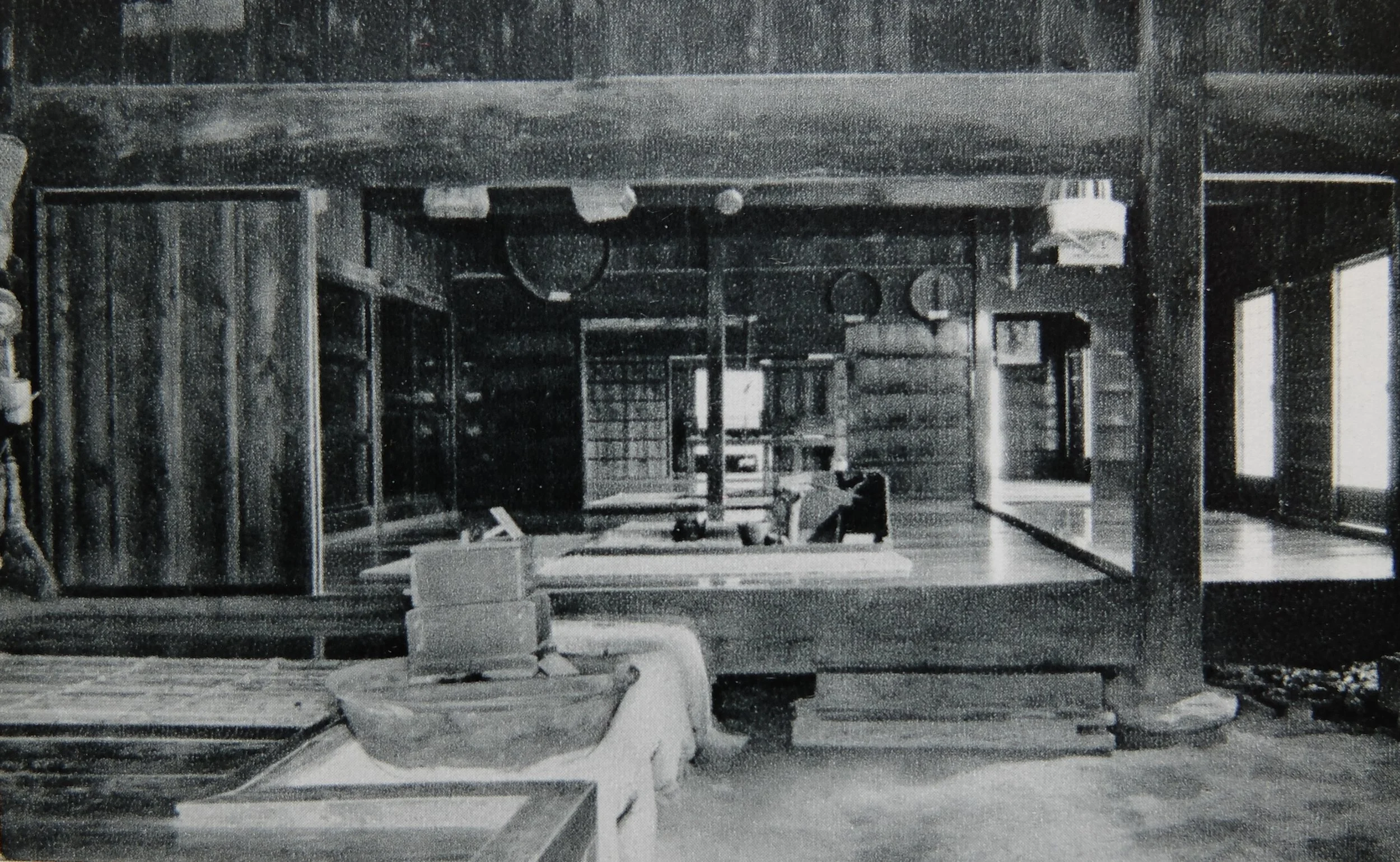
View of the interior of a sao-ya-zukuri minka, showing, from the foreground back, the earth-floored utility space (doji どじ), the everyday living and dining space, (uchinee うちねえ), the formal room (dei でい or dee でえ), and the bedroom (koza こざ). All the walls are board-clad. Between the rearward o-hara (おはら) rooms (centre) and the facade-side soto-hara (そとはら) rooms (right), there are only raised, blind floor sills (mekura-jikii 盲敷居) without any sliding fittings. Miyazaki Prefecture.
The walls are not earthen (do-kabe 土壁) but board walls (ita-kabe 板壁), both internally and externally. Roofs are thatched (kaya-buki 茅葺き) and hipped (yose-mune zukuri 寄棟造り); the scissor-like oki-senbon (置き千本, lit. ‘place thousand tree’) members that straddle the ridge and hold it in place are here called uma-nori (うまのり), and made with natural (unworked) timber (shizen-boku 自然木).
*****
This post marks the completion of this long series on minka, a loose but more or less complete translation of the second volume of the three-volume work Disappearing Minka (Horobi-yuku Minka 滅びゆく民家) by Kawajima Chūji (川島宙次). The three volumes are: the first, Roofs and Exteriors (Yane・Gaikan 屋根・外観); the second, Internal Layouts, Structure, and Interiors (Madori・Kо̄zо̄・Naibu 間取り・構造・内部); and the third, Sites and Forms (Yashiki-mawari・Keishiki 屋敷まわり・形式). I had originally intended to write only ten or so posts on the subject (in which context the decision to use Roman numerals in the titles made sense), but somehow this grew into 123 entries over almost two and a half years (by which time the Roman numerals had long ceased to seem like a good idea). I might eventually tackle one or both of the other volumes, but this blog will now be going on hiatus, at least as a weekly concern, though there may still be occasional posts on other architecture or design-related topics. Thanks for reading!