As discussed in the introductory post in this series on minka typology, sericulture has had a great influence on minka styles, and the subject of this post — the kiri-otoshi-tsukuri (切り落し造り, lit. ‘cutting dropping style’) minka of the foothills of Mt Akagi (Akagi-san or Akagi-yama 赤城山), Gunma Prefecture — are another expression of the ingenuity shown in response to the requirements of raising silkworms.
The simplest way of increasing the floor area dedicated to sericulture in minka was by making use of the roof or attic space (yane-ura no kūkan 屋根裏の空間). Once a zara-yuka (ざら床), a permeable bamboo ‘grating floor’ (sunoko-yuka 簀の子床), had been laid over the roof beams (koya-bari 小屋梁) to make the roof space into ‘silkworm rooms’ (sanshitsu 蚕室), it was inevitable that the inhabitants would, on seeing the bright light streaming in through the existing shishi-guchi (獅子口, ‘lion opening’), until then simply a small ‘smoke exhaust hole’ (kemu-dashi-ana 煙出し穴), have the idea of enlarging it into a proper window for the admittance of light and air.
The minka of this region have steeply pitched, thatched, hipped (yose-mune tsukuri 寄棟造り) roofs of jо̄ya construction (jо̄ya-tate 上屋建て), with an inner ring of jо̄ya posts (jо̄ya-bashira 上屋柱) and an outer ring of geya (下屋) posts (geya-bashira下屋柱). The roof over the geya space between these two rings is a lean-to or awning (fuki-oroshi 葺き下し) roof that is lower than and separate from the main roof. Part of the main roof is ‘cut back’ to the line of the jо̄ya posts, and it is a simple thing to build windows into the upper wall at this part, above the gently pitched, shake-clad fuki-oroshi. The windows created by cutting out the central part of the façade side of the roof are called kiri-otoshi mado (切り落し窓, ‘cut out/off window’).
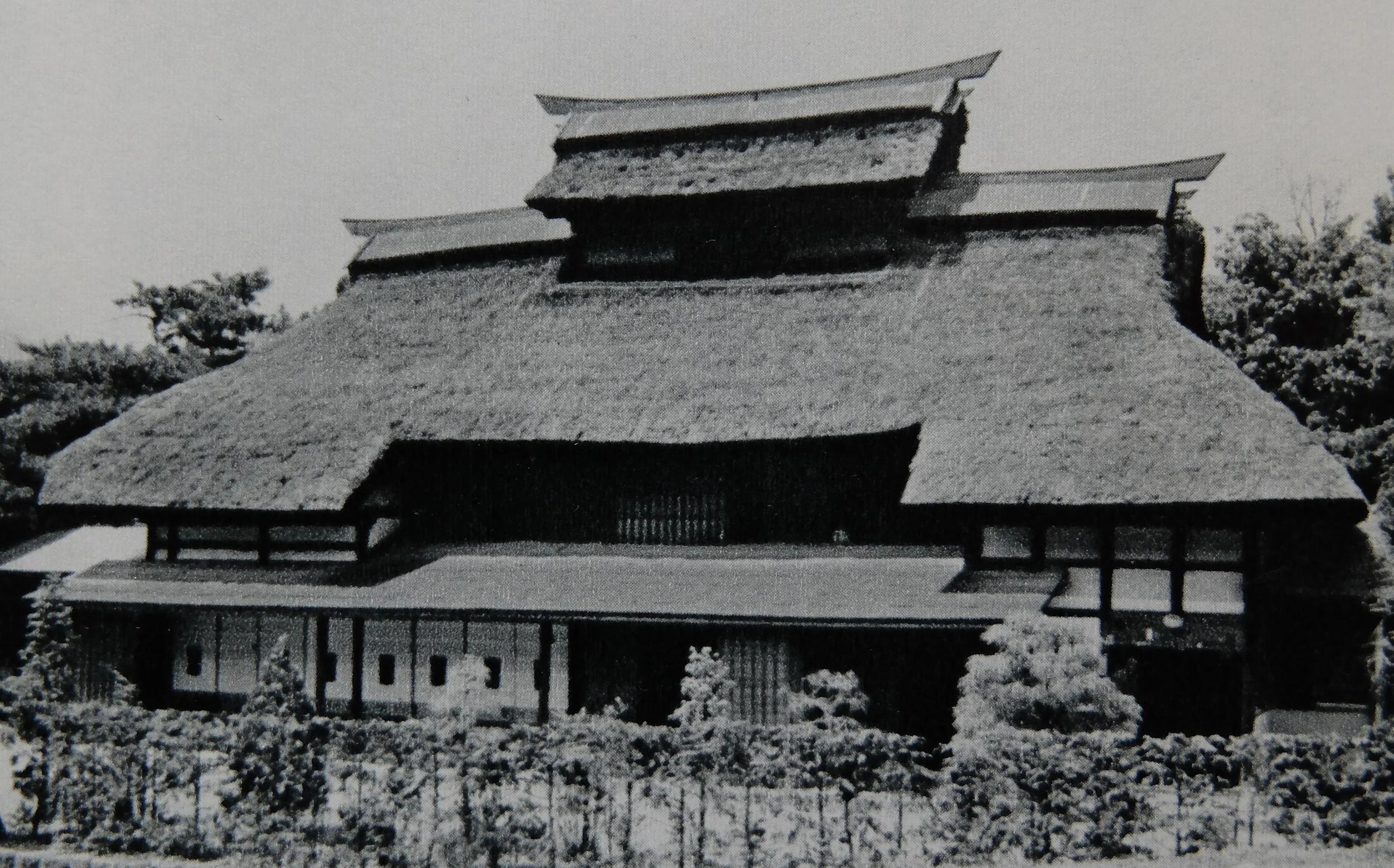
A grand minka in the foothills of Mt Akagi. A ventilation lantern (yagura 櫓) rises over the roof and the ridge has been re-clad with metal (totan トタン), but this is a ‘kigushi style’ (kigushi-tsukuri 木ぐし造り) ‘Echigo style’ (Echigo-fū 越後風) minka. Gunma Prefecture.
Because minka of this style are widely distributed across the whole area of the Mt. Akagi foothills (fumoto 麓), they are also called ‘Akagi type minka’ (Akagi-gata minka 赤城型民家), but the people of this area also call them kiri-age segai tsukuri (切り上げせがい造り, lit. ‘round/cut up jetty/eave style’), among other names. The ‘jetty style’ (segai tsukuri せがい造り) was a formal style not permitted to commoners of low status, but the fact that it had become common practice to cut away part of the segai, and call the result kiri-age segai or some other name, indicates that this style arose during the bakumatsu (幕末), the last years of the Edo period (Edo jidai 江戸時代, 1603 - 1868), when the class system was breaking down. Also, with the opening of the ports during this period, exports of raw silk thread (ki-ito 生糸) increased dramatically, and the sericulture industry entered a period of prosperity.
The economic prosperity brought about by sericulture saw a weakening of the class-based differences in formality that had previously pertained. Customs such as the construction of minka by villagers’ mutual benefit (son-min gojo 村民互助) work cooperatives (kyо̄dо̄ sagyо̄ 協同作業), such as the yui (ゆい), disappeared, and villagers took to hiring migrant worker de-kasegi (出稼ぎ) roofers (yane-ya 屋根屋) and carpenters (daiku 大工) from the neighbouring rice monoculture regions of Echigo (越後) and Aizu (会津), leaving them able to focus exclusively on their own family trade. The result of these changes was the importation of the minka styles and forms (yо̄shiki 様式) from outside regions.
In Mount Akagi’s northern foothills region (hoku-roku chihо̄ 北麓地方), which has been cultivated from ancient times, the hiroma-type interior layout (hiroma-gata madori 広間型間取り) is predominant; in contrast, in the new volcanic deposits of the southern foothills region (nan-roku chihо̄ 南麓地方), soil fertility and water availability were poor, so opening up the land for cultivation came later, with settlements only appearing from the middle of the Edo period onwards, and most minka have regular four-room layouts (seikei yon-madori 整形四間取り); their external appearance, too, is often well-ordered.
In this region, the earth-floored utility area (doma 土間) is large, and the habitable area and the working doma are somewhat integrated. The habitable part takes the ‘four-square’ (ta-no-ji 田の字) regular four-room (seikei yon-madori 整形四間取り) form, with board-floored living agari-hana (あがりはな) and dining (katte かって) spaces adjoining the doma. The southern wall of the agari-hana has a fine lattice (sama-gо̄shi 狭間格子) window; it is here that the spinning (ito-dori 糸取り) and weaving (hata-ori 機織り) are done, so it is also called the ‘spinning window’ (ito-dori mado 糸取り窓).
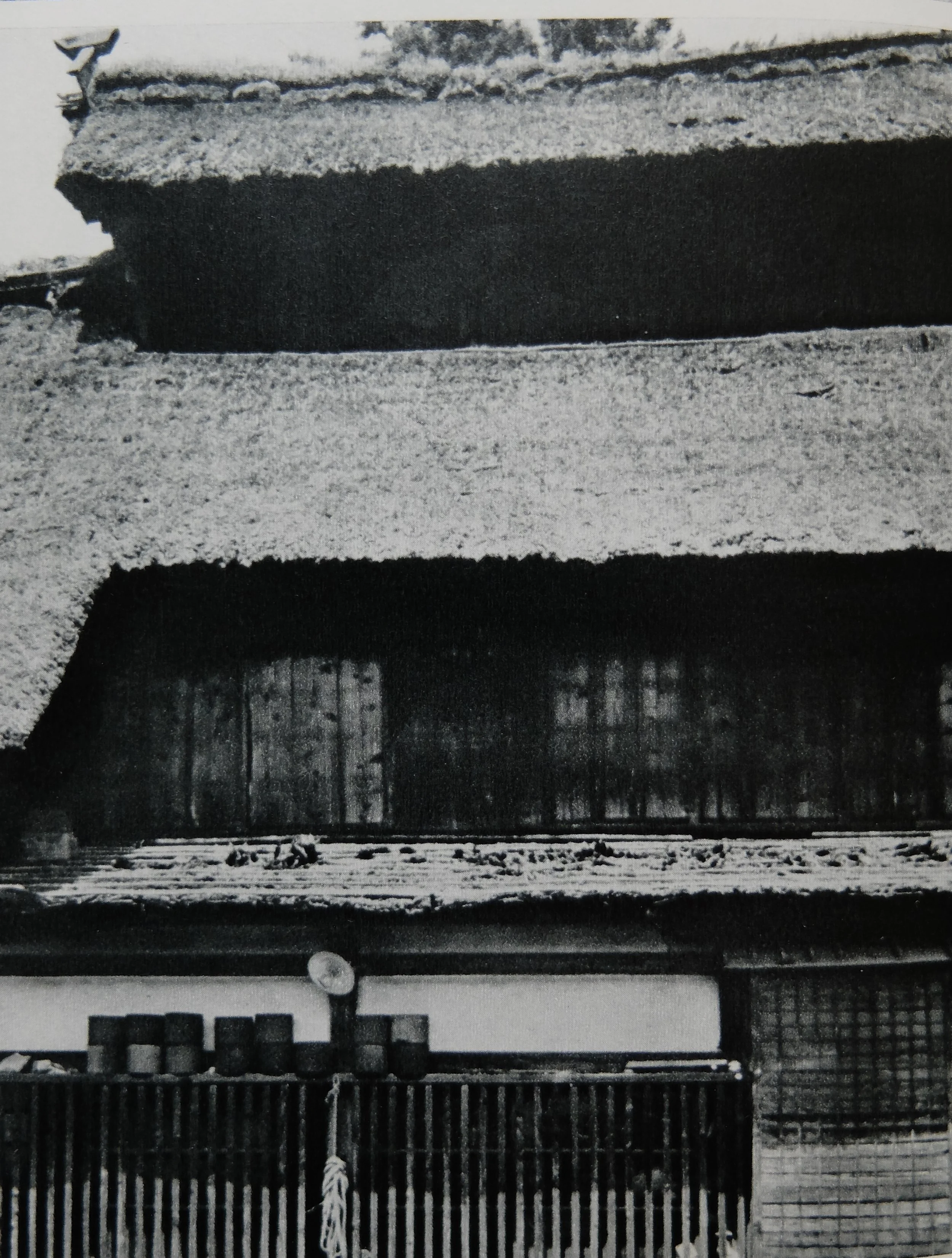
Detail of the fine lattice (sama-gо̄shi 狭間格子) of the ‘spinning window’ (ito-dori mado 糸取り窓) and surrounds. Above the ito-dori mado is the wide, centrally positioned kiri-otoshi mado (切り落し窓, ‘cut out/off window’), also called the naka-giri mado (中切窓, ‘central cut window’), and above that the ‘ventilation lantern’ (kanki yagura 換気櫓). Gunma Prefecture.
In the silkworm-rearing season, all the tatami mats are taken up from the habitable part of the dwelling. On the west side of the rooms (heya へや) there is a structure that resembles a ‘verandah’ (engawa 縁側), but the fact that the partition between it and the interior consists of board doors (ita-do 板戸) is a clue that it is not an engawa but a tatami store (tatami-ire 畳入れ ‘tatami container’).