The shumoku-tsukuri (撞木造り, ‘bell mallet style’) minka of the Tо̄kai region (Tо̄kai chihо̄ 東海地方), broadly speaking the Pacific coast-facing areas of central Honshū, have regular four-room (seikei yon-madori 整形四間取り) or front-zashiki type three room (mae-zashiki gata san-madori 前座敷型三間取り) internal layouts, but externally they appear to be of a type called buntо̄ keishiki, (分棟形式 ‘divided ridge form’), in which the dwelling consists of two structurally separate buildings, each with its own independent roof: a fully raised-floor (taka-yuka 高床) main building (omo-ya 主屋), which is the habitable part (kyojū-bu 居住部), and a cookhouse (kamaya 釜屋) that has an earthen floor (doma 土間), for ‘work’ (sagyо̄ 作業). The shumoku-tsukuri style is known locally as shuzen kamaya-tsukuri (しゅぜん釜屋造り); the name shumoku-tsukuri is said to come from the fact that the ridges of the omo-ya and the kama-ya are arranged perpendicularly to one another, in a T-shape (tei-ji 丁字), like the head and handle of a bell mallet (shumoku 撞木).
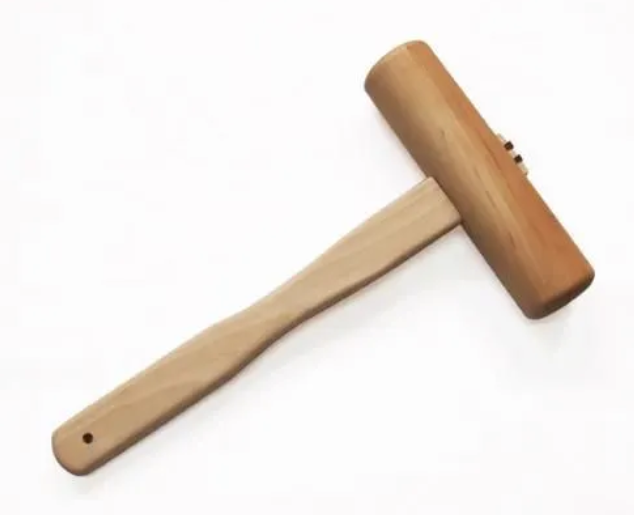
A bell mallet (shumoku 撞木).
In the past the style showed a pattern of distribution over a range corresponding with the lower reaches of the Tenryū River (Tenryū-gawa 天龍川) and the Toyo River (Toyo-kawa 豊川), but the time and effort required to thatch the many parts of the roofs is burdensome, and the waterproofness of the junction where the two roofs meet is not good, so these minka have largely disappeared. A few surviving buildings can be seen in the foothill (yama-suso 山裾) areas centred around Tenryū City (Tenryū-shi 天竜市) in Shizuoka Prefecture, to the north of Lake Hamana (Hamana-ko 浜名湖), and west of there, in Shinshiro City (Shinshiro-shi 新城市) in Aichi Prefecture.
The shumoku style is notable for lending strong support to the ‘unification theory’ or ‘merger theory’ (gо̄tai-setsu 合体説) of minka development, which places the birth of the minka at the unification of the doma-only ‘cooking building’ (kama-ya or suiji-tou 炊事棟, lit. ‘cooking ridge’) with the raised-floor (taka-yuka 高床), doma-less (mu-doma 無土間) main building (omo-ya 主屋), containing the inhabited part (zashiki-bubun 座敷部分) of the dwelling. The roofs, as seen in the image below, give the impression that an annexe (fuzoku-ya 属家) has been built alongside and adjoining the main building (omo-ya 母屋), but the interior layout is a unified whole that cannot be ‘decomposed’.
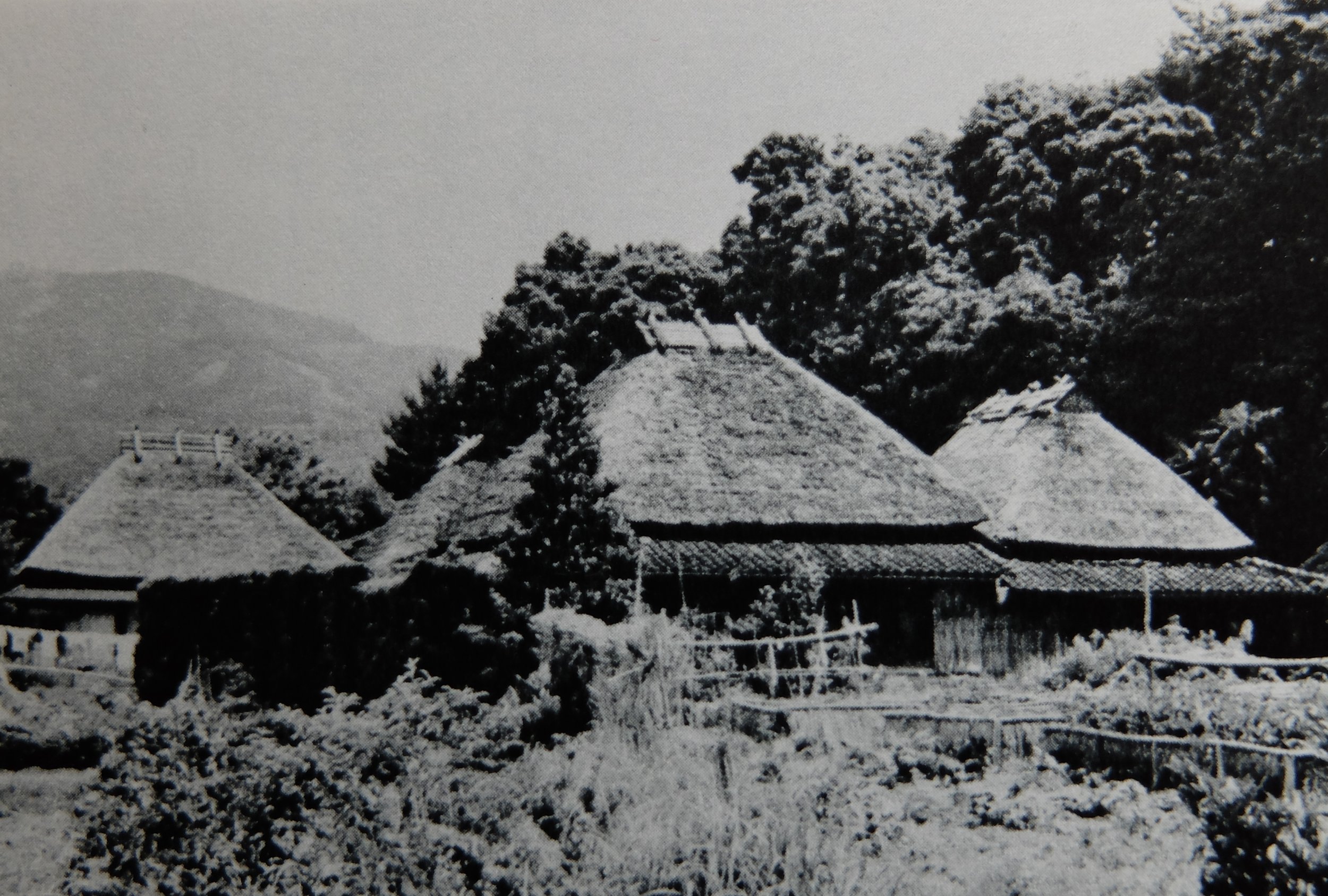
Scene of a village showing an ensemble of several near-identical shumoku-tsukuri minka. The shumoku-tsukuri of this district take a form in which the tiled eave (kawara-bisashi 瓦庇) of the omo-ya and the roof of the kama-ya are in contact. Shinshiro City (Shinshiro-shi 新城市), Aichi Prefecture.
The raised-floor omoya is composed of four rooms or spaces (yon-ma 四間): on the façade side, an ‘entry formal room’ (genkan-zashiki 玄関座敷) called the oi (おい) or oe (おえ) and a formal room (zashiki 座敷) called the dee (でえ); and to the rear of these, the dining place (shokuji-basho 食事場所) called the daidoko (だいどこ) or katte (かって), and the nando (納戸), which serves as bedroom (shinshitsu 寝室) and storage room (oki-mono 置物). There are also older examples that are front-zashiki type three-room layouts (mae-zashiki-gata san-madori 前座敷型三間取り), and a form can also be found in which both the perimeter posts and the internal partition posts are erected at one ken centres (around 1.8m) and there is no ‘verandah’ (engawa 縁側), a form called shishi-mado (獅子窓 ‘lion window’).
The ‘cookhouse’ (kama-ya 釜屋) doma is of the ‘passage niwa’ (niwa is an alternative name for doma) or tо̄ri-niwa type (tо̄ri-niwa-shiki 通り庭式), with an entry doma (iri-guchi doma 入口土間) on the façade side adjacent to the raised-floor part, and the stove (kudo 竈) installed to its rear; on the ‘outer’ (shimo-te 下手) side of the doma part are the stable (umaya 厩), and to its rear a food storage area (shokuryо̄ chozо̄ no mono-oki 食糧貯蔵の物置き) corresponding to a ‘miso room’ (miso no heya 味噌部屋). The area where the omo-ya and kama-ya meet is around one ken (around 1.8m) in width and is unified and continuous with the rest of the doma; over it, an internal gutter (uchi-doi 内樋) runs from front to back. As seen in the interior photograph shown below, the gutter is supported by connecting beams (tsunagi-bari 繋ぎ梁) that span between the posts of the two structures. In the past, these gutters were constructed of hollowed-out logs or large-section bamboo, but more recently many were of steel sheet manufacture.
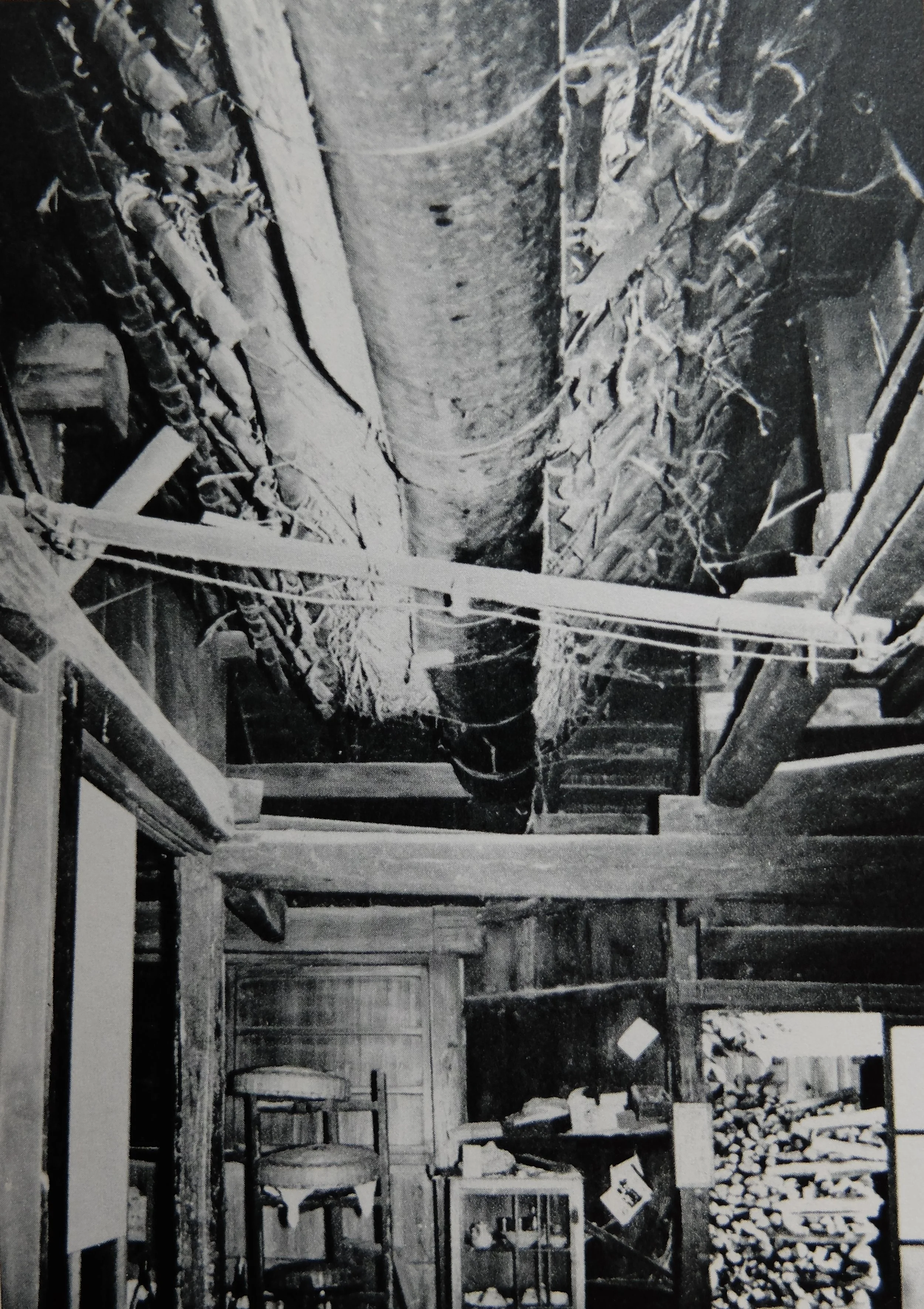
A large-section internal gutter runs in the gap where the eaves of the omo-ya and the kama-ya meet. Traditionally a large half-section of hollowed-out log or bamboo was used. Aichi Prefecture.
In the shumoku style, the ‘main post’ (daikoku-bashira 大黒柱) is not in the omo-ya; rather this title is given to the post at the centre of the ‘upper’ (kami-te 上み手) part (the part closest to the raised floor) of the kama-ya. Shumoku roofs are generally hipped; on the ridge are either gasshou (合掌, ‘praying hands’) or senbon (千本 ‘thousand timber’) style ‘ridge securers’ (mune-oe 棟押え) called ya-hazu (矢筈, ‘nock of an arrow’), but in the flatland (heitan 平坦) areas downriver, there are also ridges that are wrapped with bamboo mats, a style called takesu-maki (竹簀巻き).