As mentioned previously, this long series on minka has been sourced almost wholly from the second volume of Kawajima Chūji’s three-volume work ‘Disappearing Minka’ (Horobi-yuku Minka 滅びゆく民家). This volume, titled Layouts・Structure・Interiors (Madori・Kо̄zо̄・Naibu 間取り・構造・内部), concludes with an appendix on minka typology and styles.
The Japanese term used for ‘style’ in this context, and the word Kawajima uses, is tsukuri (つくり), or sometimes -zukuri when used as a suffix. The word derives from the verb tsukuru (つくる), which broadly means ‘to make’, and can be written either [造る], [作る], or [創る]. These kanji have some overlap in use, but [造る] means to build, construct, or manufacture a material item, generally of or on a larger scale; [作る] is to create, craft, cultivate, etc., either materially or abstractly, as in ‘create a poem’ (shi wo tsukuru 詩を作る), generally of or on a smaller scale; and [創る] is to create something afresh or for the first time, as in ‘create the universe’ (uchū wo tsukuru 宇宙を創る).
In both English and Japanese, architectural typology (kenchiku ruikei-gaku 建築類型学) refers to the academic classification of buildings into ‘styles’ or ‘types’ (tsukuri) according to their essential characteristics, whether functional, structural, or relating to external appearance. Kawajima defines tsukuri as the regional or local characteristics of a minka in a particular place, viewed holistically. As examples of these characteristics, he gives the partitioning of interior space (madori 間取り), structure (kо̄zо̄ 構造), and external appearance (gaikan 外観).
Incidentally, the suffix -fū (風, lit. ‘wind’) is also used in Japanese in an architectural context, though not with a structural or constructional sense; it carries the sense of ‘style’ only as form, look, or appearance, as for example kara-fū or tо̄-fū (唐風, ‘Chinese style’).
The style of a minka is of course influenced by climate (kikо̄ 気候), fūdo (風土, a term which encompasses both landscape and ‘culturescape’), specialised or local architectural materials, traditional methods in the crafts and trades, legal and economic conditions, and so on. But the greatest determining factor on minka style is occupation. In a functional sense, all minka have essentially the same typological classification: domestic dwelling. It is the additional, often commercial, functions taken on by minka to accommodate the livelihoods (nariwai 生業) of their inhabitants that generate the formal and even structural divergences that we read as differences in ‘style’.
Peasants on the warm plains earned their living as full-time farmers, but in mountainous or cold regions this was not possible, so many people were part-time farmers who also ran a ‘side business’. Work that was carried out away from the home, such as forestry or fishing, did not have a great influence over the style of the house, but domestic industry (yanai sangyо̄ 屋内産業) undertaken as part of the home economy, such as sericulture (yо̄-san 養蚕) or animal husbandry (chiku-san 畜産), brought about great transformations in house styles. This explains why there are many minka of strikingly local character in both mountainous areas (sanchi 山地), where sericulture was often practised, and in the cold Chūbu (中部) and Tо̄hoku (東北) regions, where animal husbandry was common. Most of these transformations in fact accompanied the prosperity brought about by export-driven sericulture, so their history is relatively recent. The famous ‘praying hands style’ (gasshou-zukuri 合掌造り) minka of Hida (飛騨), current-day Gifu Prefecture, for example, is portrayed in modern guidebooks as a style passed down from antiquity, but since it developed around the objectives and needs of sericulture, it only reached its perfection as the Edo period (Edo jidai 江戸時代, 1603 - 1868) was drawing to a close.
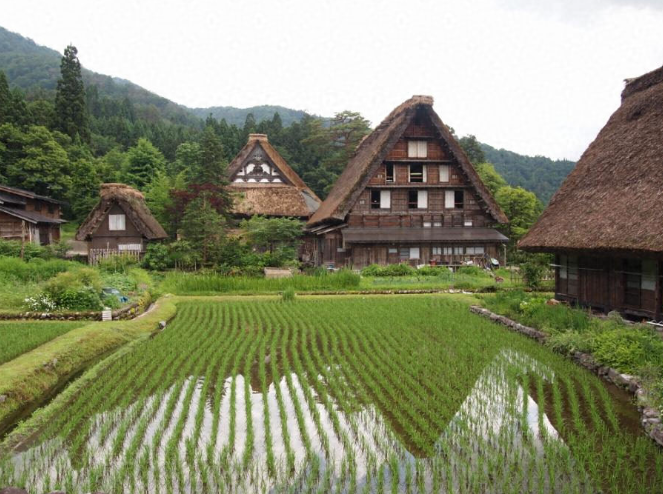
The famous ‘praying hands style’ (gasshou-zukuri 合掌造り) minka of Hida (飛騨), current-day Gifu Prefecture.